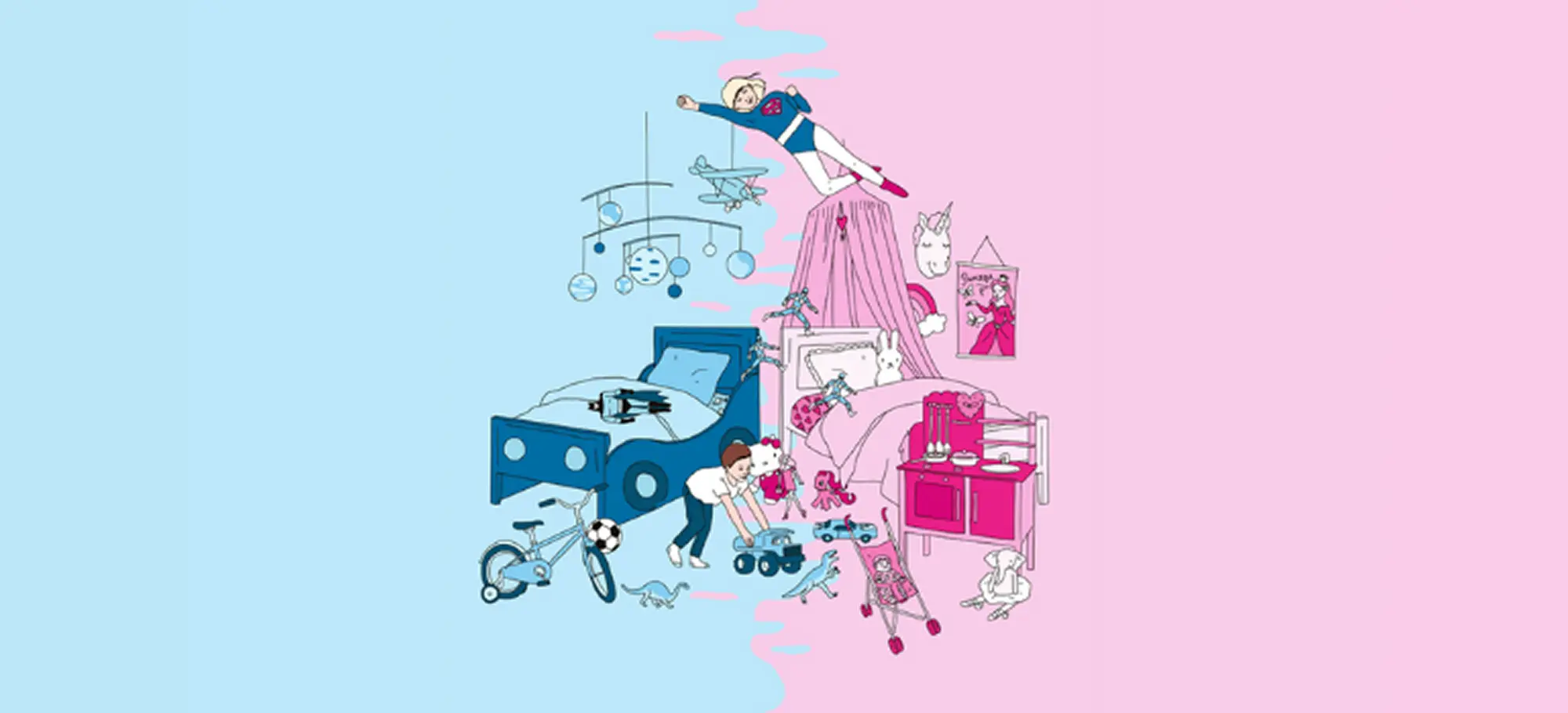
“Are women just like other men?”
Listen to it over and over again: Episode 12 of the series “Un podcast à soi,” created by Charotte Bienaimé and produced by Arte: “Are Women Just Like Other Men?”
Surrounded by academics Muriel Salle, Clémentine Vignal, and Claudine Cohen, as well as key participants such as daycare workers, teachers, and schoolchildren who took part in the “Buzzons contre le sexisme” contest, journalist Charlotte Bienaimé explores the myths that shape our perception of femininity and masculinity.
Is it true that the division of roles and functions between women and men in the human species essentially mirrors what occurs in every animal species, and that it is natural for females to care for the young? But then what are we to make of those male seahorses that carry their unborn young in a ventral pouch and put on a fabulous show when they “give birth”? What about rheas—a type of ostrich—where the fathers incubate the eggs and fiercely defend the newly hatched brood? And what about the marmoset, a famous monkey known for its incredible agility but less well-known for its exemplary fathers who care for the newborns while the mother regains her strength after giving birth?
Otherwise, is it true that prehistoric women were confined to caves (or, at best, allowed to gather berries in the surrounding area), or is this a convenient narrative for our contemporary societies that tell women their situation is no worse than that of their ancient predecessors? What if prehistoric women, far from fitting the caricature of a subjugated female dragged by the hair by a barbaric man, had actually been migrants, warriors, and hunters?
Aside from that, what are the consequences of everyday, unconscious sexism on women’s health? While we are certainly equal, we are no less different from a physiological standpoint. However, the vast majority of pharmaceutical treatments are tested on male populations, at the risk of overlooking side effects specific to women’s health. This is a question that raises concerns on one hand (male hormonal contraception, when tested on a panel of XY subjects, reveals problematic side effects: headaches, loss of libido…), yet is presented as a step forward for women’s rights in another (female hormonal contraception, though not without side effects, is still considered an overall advance for humanity).
And what do young people and those who educate them on a daily basis think about all this, given that they observe, from a very young age, both the prevalence of gender stereotypes and the fervent desire to see equality between girls and boys become a reality?
Take an hour to escape into something thought-provoking by listening to the podcast “Are Women Just Like Men?” It’s packed with food for thought to challenge stereotypes, shift your perspective, and delight in hearing the newest generation explain why equality between women and men should be a given—and never again a “problem.”
Similar news stories
-

Hortense Harang Podcast: Express Ethics Through Flowers!
-

Podcast of the Month: What Primatology Teaches Us About Gender Differentiation
-

Podcast of the Month: “Jobs Traditionally Seen as ‘Men’s Work’ Are Actually Women’s Jobs”
-
A Lifetime: Ada Lovelace
-

Webcast of the Month: Mental Load
-

Podcast of the Month: Claudie Haigneré
-

Happy Men and Women Share More
-

Podcast of the Month: Legend Ladies