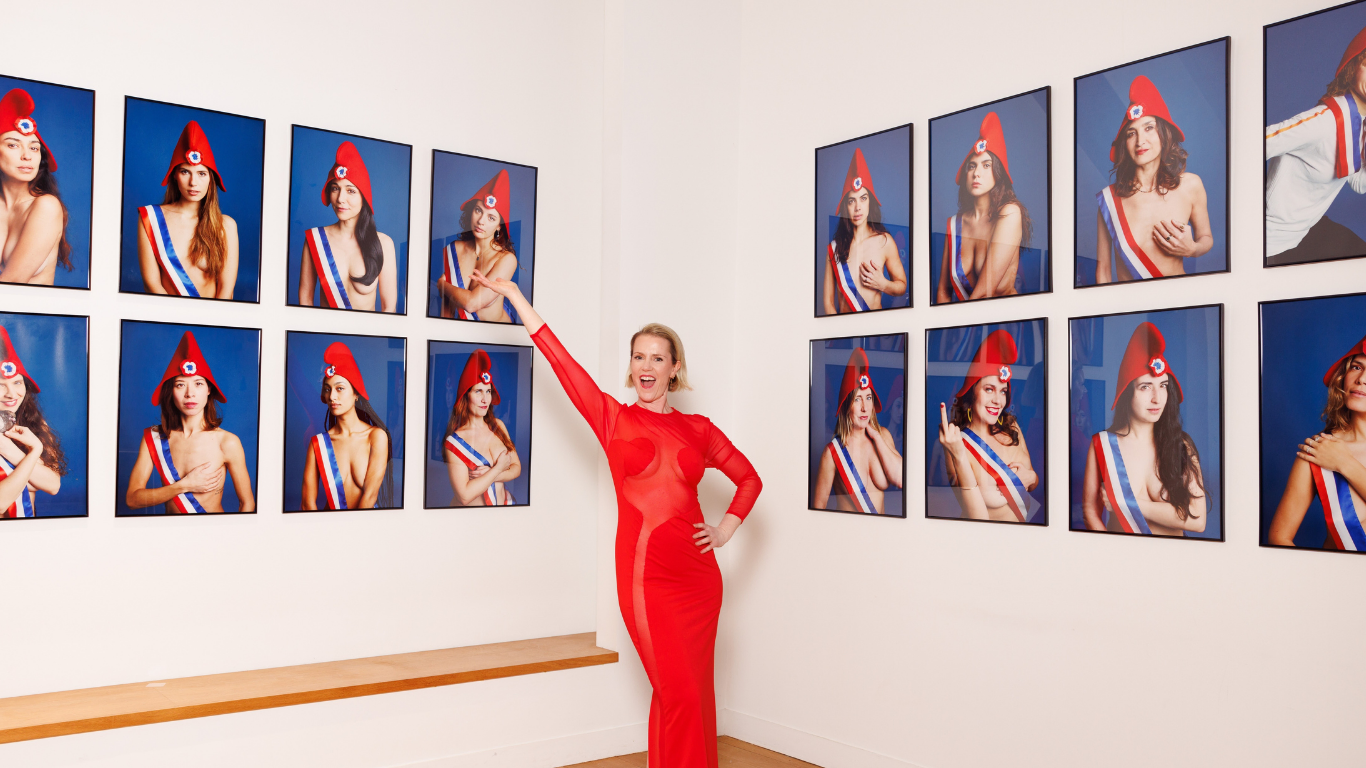
“Every Woman Embodies Marianne,” by Sylvie Castioni
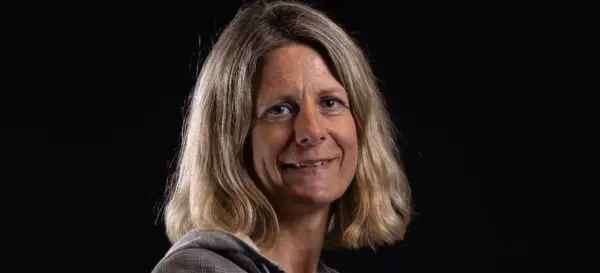
From April 15 to July 13, the Musée de La Poste, in partnership with the Parity Network “Un Une”, will showcase the work of socially conscious photographer Sylvie Castioni. Through a modern and daring reinterpretation, the artist brings together actresses, filmmakers, entrepreneurs, content creators, and a long line of female Postal workers to embody the republican figure of Marianne and celebrate diversity. More than just an exhibition, it is a vibrant tribute to all women. Interview.
What sparked the idea for the “Marianne” project?
It’s a long story. Before becoming a socially conscious artist, I worked for 15 years in the fashion industry as a photographer. I photographed very thin young women, following very established standards. Then, ten years ago, I discovered that my best friend at the time was abusing models. It was a huge shock to me. I became aware of the violence that I hadn’t seen—or didn’t want to see—in the fashion and film industries. The trial took place two years ago. I stayed on the courthouse grounds for two weeks before testifying on the stand, reflecting, and talking with these young women. That bond and that sisterhood left a deep impression on me: they are the true bulwarks against patriarchy. In fact, it was thanks to that sisterhood and the collective momentum that the trial was won, resulting in a sentence of 16 years in prison without parole. As I was leaving, I saw images of Marianne all over the walls of the courthouse. Something happened subconsciously. I wanted to celebrate this sisterhood and reaffirm our rights.
Marianne is supposed to represent Liberty, Equality, and Fraternity, but these are values we still don’t see enough of in our daily lives. Marianne was created by men in 1792. What have we done with her? Do women truly benefit from this motto? I wanted this project to serve as a reminder.
How did your collaboration with La Poste come about?
It happened very naturally. Marianne is a central figure at La Poste, particularly through the postage stamp. For my part, I had already been working with the Group for three years on films highlighting women in leadership roles. Through my collaboration with La Poste, I saw that issues of gender parity and pay equity were ever-present. And I found there what I couldn’t find in the fashion industry: allies, such as Isabelle Parthonnaud and Aurore Mayer.
From that point on, Marianne became a dual symbol: that of the Republic and the postage stamp, of course, but also that of strength. She is a universal figure. It’s no coincidence, after all, that the Phrygian cap was the mascot of the Olympic Games!
Through your lens, every woman becomes a symbol of the Republic. What message do you hope to convey?
The project brings together women from the culture sphere who speak out powerfully. But there is also, for example, a specific photo of a line of female postal workers—a granddaughter with her mother and grandmother—to show that every woman, regardless of her age or background, embodies Marianne. We can all be Marianne because we all have the right to dignity.
The exhibition reflects our society, but also the way we treat women. For example, I had a harder time finding older women because society projects a negative image of them onto them. Yet I am committed to championing the diversity of beauty. Beauty is everywhere; it isn’t limited to a single standard. I want women to be able to embrace their bodies without being forced to conform to a codified ideal of beauty.
La Poste provides the project with a massive platform. What impact does this visibility have?
This visibility is essential! There’s a long-standing connection between the French people and La Poste. Everyone has a special connection with La Poste, so the message resonates all the more strongly. Art builds bridges, and partnering with a company that’s everywhere allows us to touch people right in their hearts. And the more visible the exhibition is, the more people engage with it. In Nice, the exhibition was on the street, and people were chatting in front of the panels—grandmothers with their little girls, couples… It was fascinating. Marianne opens the door to a thousand topics, from our relationship with the body to the figure of the nurturing mother.
Do you have any particularly vivid memories of those photo shoots?
I have plenty of them. One that comes to mind is Mira, a young pianist who was cyberbullied. When it came time for the photoshoot, she finally agreed to take off her corset and pose topless. She reclaimed her body and received wonderful feedback from her community.
Andréa Férréol, a 79-year-old actress, didn’t hesitate for a second to bare all for the cause and sweep aside prejudices about the aging body.
I never force anyone to pose topless, but with my supportive gaze, these women often end up wanting to reclaim that power. They feel empowered and connected to one another, like a feminine constellation. In fact, at first, I photographed them topless because that is the traditional depiction of Marianne. But I had to stop to avoid censorship. This also says a lot about the hypersexualization of the female breast today.
Pour finir, si vous deviez définir cette exposition en trois mots ?
Liberty, Equality, Fraternity. Our motto reimagined through a feminine lens!
Similar news stories
-
“Giving women’s voices a platform is what leads to everything else.”
-
September Editorial by Aurore Mayer: Gender Parity—An Inspiration for Transformation, a Breath of Fresh Air for the Organization
-
Un Une: Two new episodes of “A part Egale” you won’t want to miss this summer
-
July Editorial by Aurore Mayer: Summer—Time for a Midyear Review Before a Well-Deserved Break!
-
May Editorial by Aurore Mayer: Gender Parity, a European Vision
-
Profile: Stéphanie Humbert, Establishment director
-
March Editorial by Aurore Mayer: March 8… And the Rest of the Year!
-
January Editorial by Aurore Mayer: Let’s Make 2026 a Year in Which Gender Parity Is a Given