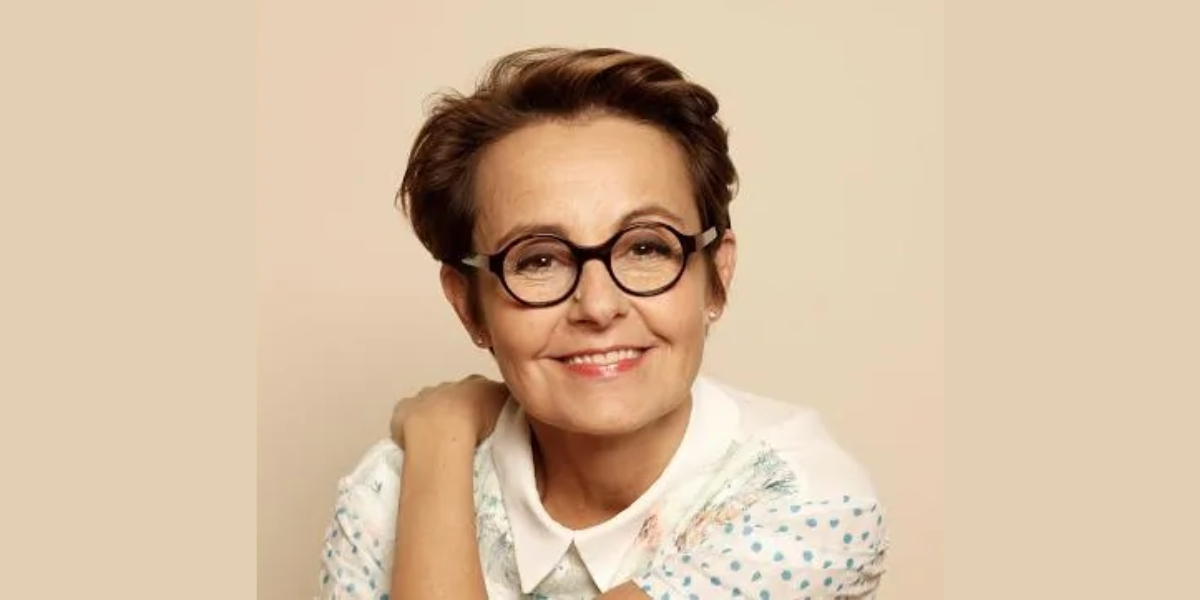
Florence Servan-Schreiber: “We all have superpowers”
An opportunity to learn from Florence Servan-Schreiber—author, speaker, and trainer—about the benefits of positive psychology.
The Adventures of the Girlz in the Bank Keep it up! This will enrich them and equip them so that, perhaps one day, they can mentor other aspiring Girlz in the Bank.
How did your professional and personal journey lead you to work in the field of positive psychology?
“As the ‘little sister’ of psychology in general—which is invaluable and there to help us heal—positive psychology takes a preventive approach by focusing on personal fulfillment.
My current job is to be a professor of happiness, to share—in various ways—the findings of studies conducted by researchers on positive psychology and on the behaviors and attitudes that work. It’s the ‘science of happiness.’ But be careful—it’s not the same thing as positive thinking. Positive psychology studies people like you and me and the evolution of their well-being.
I first became interested in it when I was unexpectedly laid off from my previous job. I trained in this field in the United States, and upon my return, I took over from my cousin David as head ofthe French EMDR Institute. I delved deeper into what I now call “superpowers.””
What are these superpowers?
“After my training, I wondered what it was that allowed an ordinary person, in an extreme situation, to accomplish things for which she was unprepared.”
Researchers realized that human qualities had never been cataloged before. Diseases had been, but not qualities. They identified 24 of them and traveled the world to meet with groups of people in order to test their universality. This allowed them to conclude that the fact that these qualities are present to a greater or lesser degree in each of us depends neither on our upbringing nor on our occupation.
They then developed a questionnaire to rank these qualities in order of prominence. The top five are the ones that shape our personality; these are our strengths. They are what drive us and give us our power.
Knowing your character strengths—your greatest qualities—is like having a compass to guide your own life. When I realized that I could only rely on my own qualities to move forward, I was able to write my first book. I’ve written seven more since then.
Often, when we encounter difficulties in a situation, we’re convinced that we’re lacking a certain skill, when in fact we’re simply relying on something other than our strengths. We spend a lot of energy trying to correct our flaws. This drains our energy in an unsustainable way! We need to realize that there are as many ways to reach our destination as there are people on earth.
“But be careful—it’s not like a carnival every day. The more pressure we’re under, the more we forget to tap into our strengths.”
We don’t celebrate our strengths very often, mainly because we don’t even name them. How can we deal with that little inner voice inside us—one that isn’t always very “positive psychology”?
“We’re naturally programmed to notice the negative—it’s linked to our survival instinct. This negative bias is everywhere. It’s exactly the same when it comes to how we view ourselves.
An inner voice is constantly speaking to us. We need to pay close attention to this little voice’s tendency to lean toward the negative, to the way we talk to ourselves, and to what we tell ourselves. We tend to do this especially when things aren’t going well or when we’re upset. For example, we can give a name to this inner voice to help us learn to step back and gain perspective.
“In general, we need to learn to be kinder to ourselves. Let’s be our own best friend. No one else can fill that role better than we can!”
Why can’t material abundance satisfy us as much as we imagine it would?
“Human beings have a remarkable ability to adapt to anything. Things change, we adapt, and then the situation becomes our new normal. It’s the same with material possessions. Once we obtain the thing we covet, we quickly get used to it, and it loses its appeal.
That is why the true abundance we should strive for is that of focus and time well spent.
The happiest moments are those in which we apply our skills toward a goal that will provide us with feedback. The right level of personal engagement occurs when the level of difficulty is just right. We become so focused that we lose all sense of self—we no longer “talk” to ourselves.
“There are many different balances to strike in life, but the most interesting one is the balance between activities that drain our energy and those that replenish it.
The fragmentation of activities, for example, takes a huge toll on our satisfaction.”
Any conclusions?
“If things aren’t quite the way you’d like them to be right now, first focus on drawing on your inner strengths, and then make the most of your social connections! Those micro-moments of love—the moments when you feel connected to someone—will fill you with energy.”
Similar news stories
-
“Giving women’s voices a platform is what leads to everything else.”
-

September Editorial by Aurore Mayer: Gender Parity—An Inspiration for Transformation, a Breath of Fresh Air for the Organization
-
Un Une: Two new episodes of “A part Egale” you won’t want to miss this summer
-
July Editorial by Aurore Mayer: Summer—Time for a Midyear Review Before a Well-Deserved Break!
-
May Editorial by Aurore Mayer: Gender Parity, a European Vision
-
Profile: Stéphanie Humbert, Establishment director
-

“Every Woman Embodies Marianne,” by Sylvie Castioni
-
March Editorial by Aurore Mayer: March 8… And the Rest of the Year!