Five Feminist Figures in Mentoring
In a professional world still shaped by unspoken norms, we need role models and mentors to help us express our ambition, envision our future, and set career paths that live up to our talent. For a long time, women have had to forge their own paths by observing career trajectories in which they were not the protagonists.
Yet history is full of women who have passed on confidence, skills, and legitimacy—often long before the word “mentoring” became part of HR policies. We often talk about inspiring figures and supportive people who have given others a leg up… But did you know that there are also feminist figures who have explicitly helped women get a foot in the door?
Meet some historical figures in the field of mentoring—some of whom were pioneers in their own right!
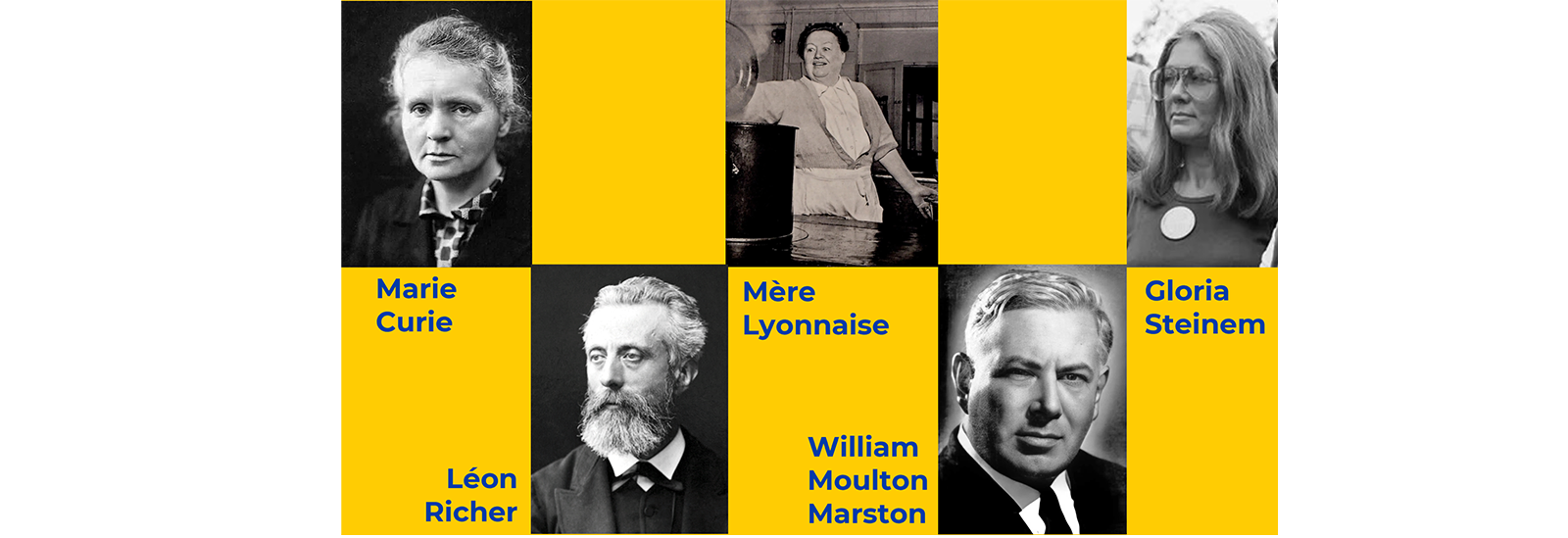
1. Marie Curie (and the 45 women who grew up in her laboratory)
Why She Is an Inspiration
We know Marie Curie, the iconic scientist and the first woman to receive a Nobel Prize, but we know less about the 45 women who worked in her laboratory. Historian Natalie Pigeard-Micault highlights this in her book *The Women of Marie Curie’s Laboratory* : by making room for young women who wanted to pursue science, Marie Curie unwittingly promoted inclusion, creating an environment where their talent could be fully realized.
Don’t fall into the trapof the “Marie Curie complex,”which involves idolizing an “exceptional woman” at the risk of discouraging the ambitions of all those who might not feel capable of holding a candle to her! Instead, look at the work of the real Marie Curie—the one who accomplished incredible things herself but who also opened the door behind her for other talented women…
Act like Marie Curie
- Create inclusive micro-ecosystems: spaces where the presence of women is not the exception but the norm.
- Recognize contributions, even those that others overlook
- Don’t try to be perfect: role models are human, and it’s their vulnerability that inspires us.
- Help talent shine rather than hog the spotlight: a mentor isn’t a solo star—they’re a multiplier.
- Pave the way in practical terms: provide access to projects, responsibilities, and visibility.
2. The Mothers of Lyon (When the Kitchen Becomes a Space for Empowerment)
Why They Inspire
In the early 20th century, these self-taught female chefs transformed their experiences as cooks in upper-class homes into haute cuisine restaurants. Mère Brazier would even become the first woman to earn three Michelin stars.
Without theorizing about female leadership, they created a pragmatic sisterhood: they trained one another, shared their techniques, paved the way for future female chefs, and claimed a public space that had previously been denied to them. A silent revolution, carried out behind the stoves.
Do it like the mothers of Lyon
- Pass on your knowledge freely: share recipes, tips, and your network.
- Build a community: Success is stronger when it’s built together.
- Use generosity as a professional tool: giving also means helping others grow.
- Train, encourage, and help employees develop their skills—without waiting for a formal framework.
3. William Moulton Marston (and the Wonder Woman Experiment)
Why He’s an Inspiration
In the 1940s, this psychologist explored how superheroes influence children’s ambitions. After observing Superman’s impact on boys, he wondered: What about girls? As a result, hecreated Wonder Woman tooffer young girls a strong, talented role model.
Despite the subsequent excesses of sexualization, his original intention remains groundbreaking: to prove that legitimacy is built through identification. As Marston also points out, desire, confidence, and ambition are also fueled… in the mind. Enough with limiting beliefs, so to speak.
Play it like Marston
- Provide relatable role models, not perfect ones: it should still be possible to identify with them.
- Show your own vulnerabilities: they make success attainable.
- Help foster ambition: encourage, reinforce, and highlight strengths.
- Never underestimate the power of stories: stories change the course of people’s lives.
4. Gloria Steinem (and the art of bringing communities together)
Why She Is an Inspiration
A journalist and activist, Gloria Steinem spends her life “on the road,” documenting the experiences of minorities in the United States. She understands that isolation divides people, and that only a collective voice can change the status quo.
By providing single-sex spaces where bonds between women and people of color are strengthened, she becomes a true “community manager” in the literal sense of the term. Her efforts will enable countless people to feel stronger, more visible, and more empowered to take their rightful place in the world.
Do it like Steinem
- Build a community: create safe spaces where people can speak freely.
- Encourage group discussions, not just individual ones.
- Help isolated talents connect with one another.
- Leverage collective intelligence and create the conditions that foster it.
5. Léon Richer (the ally who puts his network to work for women)
Why He’s an Inspiration
A 19th-century journalist, Freemason, and freethinker, Léon Richer championed gender equality with visionary clarity: equal pay, working conditions, women’s health… He covered it all.
But her most powerful contribution lay in her ability to mobilize her network of influential men—notably Victor Hugo—around the “women’s banquet” of 1870, to give women visibility, legitimacy, and a platform. That’s what true advocacy looks like…
Play it like Richer
- Open your address book and tap into your network to support and encourage the people you mentor
- Open doors, recommend women, and put women in leadership positions.
- Make room—in practical terms—by sometimes giving up your own space.
- Understand that equality moves forward thanks to those who truly put themselves on the line.
So many inspiring role models to help you build a strong and inclusive mentoring culture! Because feeling confident isn’t something you learn from books—it’s something you cultivate through interactions with those who show us the way.
Similar news stories
-

When Inspiration Comes from Elsewhere: Three International Initiatives We Can Learn From
-

3 Initiatives That Make a Difference in the Fight for Gender Equality
-

5 Cultural Recommendations for This Summer
-
The 5 Key Milestones in the Advancement of Women’s Rights That We Owe to Europe
-

The 5 European Leaders Driving Gender Equality
-

5 Resources to Help Ensure Women Are No Longer Invisible in History
-

Our Recommendations: Gender Equality in Music
-

Is Diella the ideal woman?