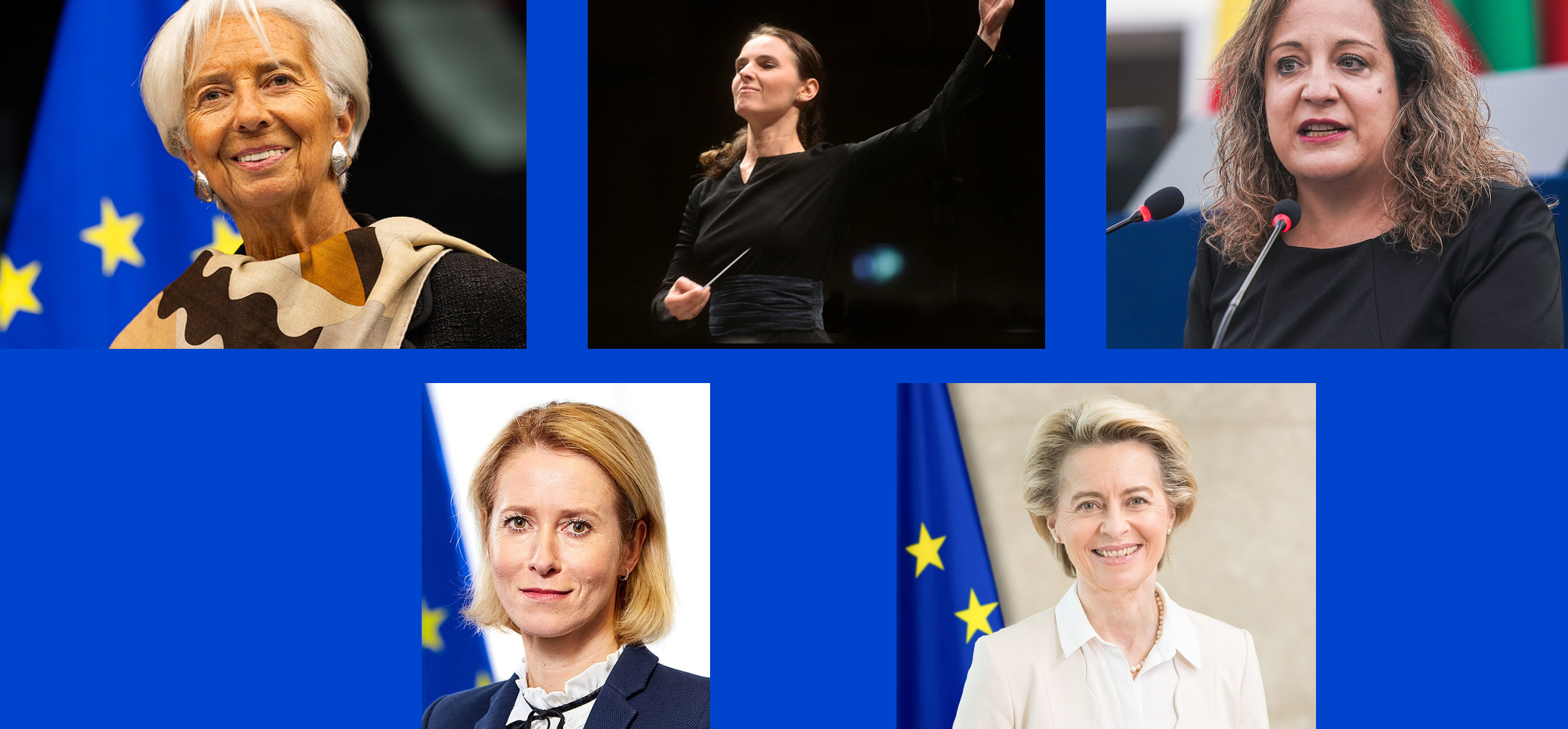
The 5 European Leaders Driving Gender Equality
Since the signing of the Treaty of Rome in 1957, gender equality has been one of the fundamental values of the European Union (EU). But how does this translate into action, and above all, who are the figures who embody the realization of this principle so dear to the European community? Here is a non-exhaustive list.
1. Ursula von der Leyen—Europe’s most powerful woman:
In July 2019, Ursula von der Leyen, a German politician, became the first woman to serve as President of the European Commission. In addition to the powerful symbolism of having a woman at the helm of the EU’s executive branch, she has championed numerous initiatives to promote gender parity within the Commission, notably requiring member states that do not reappoint their outgoing commissioner to nominate one candidate of each gender. While gender parity has not yet been fully achieved, the number of female commissioners has increased significantly thanks to her efforts: the percentage of women has risen from 11% in 1989 to 40% today. Under her presidency, major directives promoting gender equality were also adopted: the “Women on Boards” directive (2022), which requires large publicly traded companies to have 40% women on their boards of directors by 2026, as well as the very first European directive to combat violence against women (May 2024), which criminalizes certain forms of violence and harmonizes penalties across member states.
2. Kaja Kallas—Europe’s New “Iron Lady”:
Kaja Kallas is an Estonian politician who, since 2024, has served as Vice President of the European Commission and as the EU’s High Representative for Foreign Affairs and Security Policy. In short, this means she is a leading figure in European diplomacy. Since 2022—when Russia invaded Ukraine—Kaja Kallas, then Prime Minister of Estonia, has taken a firm stance and shown unwavering support for Ukraine, a position she has maintained in her European roles. Her relentless criticism of the Kremlin has earned her the nickname the new “Iron Lady of Europe.”
3. Christine Lagarde – Breaking the Glass Ceiling:
Christine Lagarde, who has served as President of the European Central Bank since 2019, seems to soar to new heights wherever she goes, amid the clatter of shattering glass. Indeed, this French lawyer and politician is a repeat trailblazer: the first woman to chair the Executive Committee of Baker McKenzie, at the time one of the world’s largest law firms; the first woman to serve as Minister of the Economy in France—and indeed among all G8 countries; the first woman to serve as Managing Director of the International Monetary Fund (IMF), and finally, the first woman to serve as President of the ECB. What is interesting about Christine Lagarde’s career is that she has made her mark in fields traditionally dominated by men: the global economy and finance. In doing so, she is opening up new possibilities for future generations of young women.
4. Oksana Lyniv – Brilliance and Conviction:
Oksana Lyniv, a Ukrainian conductor, is the first woman to be invited to conduct at the prestigious Bayreuth Festival in 2021. A year later, she became the first female music director of an Italian opera house when she took the helm of the Teatro Comunale in Bologna.
She has conducted at numerous prestigious opera houses in Europe and across the Atlantic—she will make her debut in 2024 at the Metropolitan Opera in New York.
In addition to her musical achievements, Oksana Lyniv is a prominent figure in Ukrainian cultural life and, since 2022, a socially conscious artist who uses her fame to champion her country’s cause. In 2024, she notably put her participation in the Vienna Festival on the line to demand the removal of a Greek-Russian conductor whose Russian ensemble was funded by VTB, Russia’s largest bank—which, moreover, was subject to European sanctions—and she succeeded in her cause.
5. Iratxe Garcia Perez – a leading activist:
A Spanish politician and Member of the European Parliament since 2004, Iratxe Garcia Perez served as chair of the Committee on Women’s Rights and Gender Equality in the European Parliament from 2014 to 2017, and then as chair of the S&D Group (the Progressive Alliance of Socialists and Democrats in the European Parliament) since 2019, Iratxe García Pérez is one of the most consistent advocates for women’s rights within the European institutions. Her Group, the second-largest in the Parliament, has played a key role in shaping key legislation advancing gender equality in Europe: the Pay Transparency Directive, which aims to close the gender pay gap, as well as the first European directive to combat violence against women, adopted in 2024. She also made headlines in 2017 when, after a Polish member of the European Parliament justified the wage gap between men and women by claiming that women were “less intelligent and weaker than men,” she retorted: “I know it pains you and concerns you that today, we women can represent the people on the same terms as you. From this seat, I will defend European women against men like you!”
We could have mentioned many others, such as Teresa Ribera, Executive Vice President of the European Commission since 2024, in charge of the Green and Fair Transition, or Sanna Marin, the former Prime Minister of Finland—the world’s youngest leader at age 34, at the helm of a predominantly female coalition—… But it’s important to remember that there is still a long way to go before true gender equality is achieved in Europe, and that we need, now more than ever, men and women to follow in the footsteps of these inspiring figures.
Similar news stories
-
When Inspiration Comes from Elsewhere: Three International Initiatives We Can Learn From
-

3 Initiatives That Make a Difference in the Fight for Gender Equality
-

5 Cultural Recommendations for This Summer
-
The 5 Key Milestones in the Advancement of Women’s Rights That We Owe to Europe
-

5 Resources to Help Ensure Women Are No Longer Invisible in History
-
Five Feminist Figures in Mentoring
-
Our Recommendations: Gender Equality in Music
-

Is Diella the ideal woman?