A Look Back at the “Toutes Marianne(s): Liberty, Equality, Fraternity” Event
A Guided Tour Through the World of Portraits
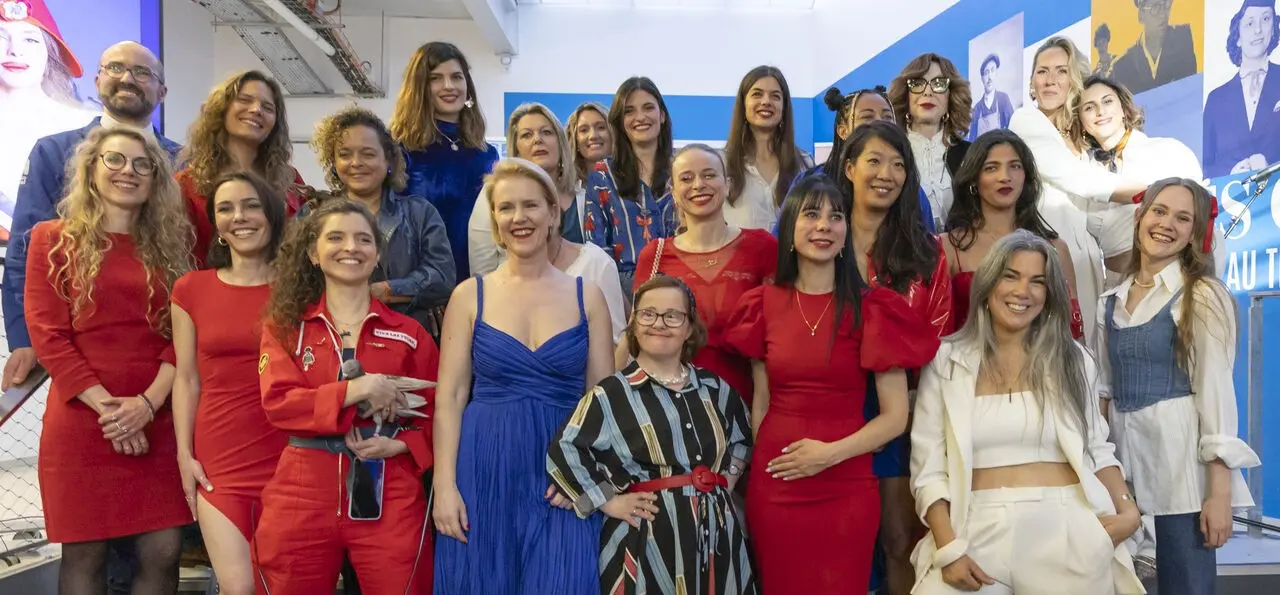
During the guided tour for the ambassadors of the “Un Une” network, Sylvie Castioni presented the 92 portraits that make up the exhibition, ranging from Claudia Tagbo to Sylvie Tellier, including Esther Abrami. This number is no coincidence, as it echoes the creation of Marianne in 1792, a figure originally conceived by men. The exhibition’s framework is thus established: to reclaim this symbol and offer a vibrant, multifaceted interpretation of it. For the exhibition also goes beyond the realm of photography. Moving portraits, audio testimonials, digital installations… These various formats offer a behind-the-scenes look at the works and the stories of the women who agreed to pose.
Behind every image lies a unique moment. The photo sessions become genuine spaces for conversation, often on the couch in Sylvie Castioni’s studio—which she calls her “confessional”—or sometimes in a more intimate setting, such as her kitchen, where she welcomed Louise Aubry. In these suspended moments, the participants open up about their stories, their relationship with their bodies, or their aspirations, making each portrait a record of a personal experience. This intimate dimension is extended through the wearing of the Phrygian cap, a central element of the portraits. The photographer explains that it elicits a wide range of reactions, from laughter to tears. Dating back to antiquity, this symbol evokes emancipation and the transition from a state of servitude to freedom.
And to embody sisterhood as authentically as possible, Sylvie Castioni chose to step in front of the camera herself to take her own portrait. In it, she is pictured with a big smile. “I’m happy today,” she says; but with her hands cupped behind her ears, as if to amplify an echo. A symbolic gesture, she explains, paying tribute to the women who—especially since #MeToo—have spoken out to denounce their experiences without always being heard. Finally, the exhibition concludes with a particularly symbolic image: three generations of female postal workers—Jacqueline, Vanessa, and Marcelle, grandmother, mother, and daughter—gathered together in front of the camera. This photograph illustrates the idea of a bond between women across time. “I called the work *The Rhizome of the Mariannes* because it reminds me of just how interconnected we all are—through our own history and that of women across the centuries. It’s a root without hierarchy,” explains Sylvie Castioni.
A roundtable discussion to continue the dialogue
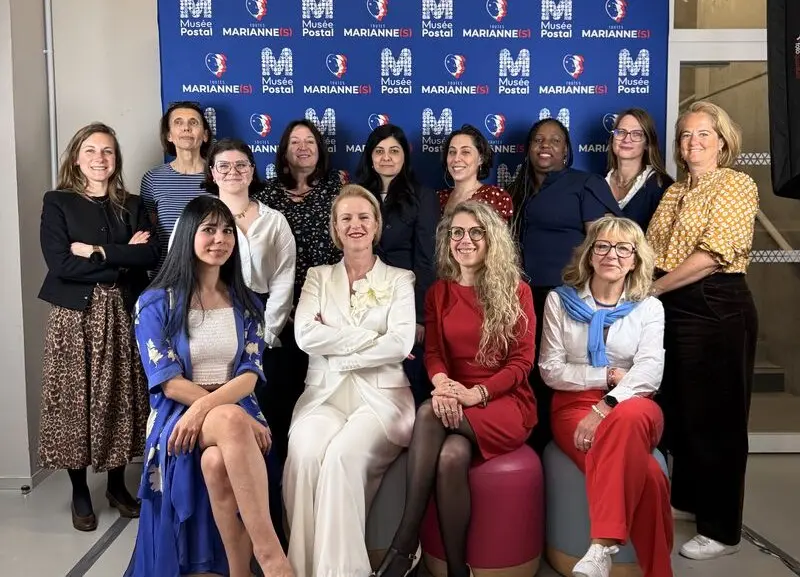
The event continued with an exclusive discussion featuring photographer Sylvie Castioni, exhibition curator Annelise Stern, and Jodie Coste, a singer-songwriter, ambassador for the National Union of Families of Femicide Victims, and also featured as Marianne in the exhibition. The discussion began with the origins of the project.
Sylvie Castioni explained that she began this work after her former best friend was accused of raping about ten young models and actresses. She reveals that he has since been sentenced to sixteen years in prison. It was in the hallways of the courthouse, during the trial, that she says she first encountered the figure of Marianne. “It’s a personal and artistic response to the injustices I’ve witnessed,” she confides, noting that “the personal is political.” While the starting point is difficult, the photographer emphasizes art’s healing role: “It’s not a joyful beginning, but we transform life’s trials, because art allows us to heal. It’s a space that shifts consciousness and touches on parts of ourselves we’d rather not see.” Annelise Stern expanded on this reflection by highlighting the project’s significance: “When there’s a happy ending, it needs to be told, because this exhibition is, above all, about justice.”
Jodie Coste, who is also deeply involved in the field, highlighted the work of her organization, which operates on several levels. This includes supporting families who are victims of femicide, collaborating with the Ministry of Justice, helping to train police officers at various Family Centers throughout France, and raising awareness in schools, among other initiatives. She also shared some striking statistics: “There is an attempted femicide every seven hours in France, and the age at which the first sexual assaults occur has decreased between 2024 and 2026.”
Reflecting on the civic aspect of the initiative, Annelise Stern pointed out that many people believe it is a government-led project. “That’s not the case,” she emphasized. “It’s a citizen-led project driven by women. What interests us about Marianne is that she is becoming a collective.” She continued: “Marianne is a symbol of justice and freedom. We also need to reclaim these symbols, which are sometimes co-opted by the far right—such as the blue-white-red and the Phrygian cap.”
The roundtable concluded with a message of thanks from Jodie Coste: “You have created something that could have existed elsewhere—and in a much less successful form—and that could have embodied other, less uplifting things. I also feel a sense of responsibility, because today, when people see me as Marianne, they understand that it makes perfect sense.”
A public inauguration organized by the Mariannes
The evening continued with the presence of about fifteen “Mariannes,” who gathered on stage during the public opening of the Postal Museum, hosted by the Franco-Belgian-British journalist and TV host Sandy Heribert, who is also a friend of Sylvie Castioni. Several personal accounts punctuated the event, notably that of dancer Dalia Salimo, who reflected on what it means to flourish in her body as a woman, as well as that of the Afghan taekwondo athlete, Marzieh Hamidi, born in Iran and exfiltrated to France, for whom Marianne must be a symbol that transcends borders. “I also think of Afghan women, who are now excluded from school, work, and public spaces, as if their mere presence had become unbearable and as if their freedoms were to be forgotten. But history teaches us one important thing. You can’t erase women; you can’t silence freedom forever,” she tells us.
The evening also featured musical performances by Jodie Coste and Kee-Youn Kim. “Un Une” serves as a fitting summary of the exhibition’s essence: diverse, socially conscious, and driven by the voices of women who, together, are redefining the image of a resolutely contemporary Marianne.
Similar news stories
-
2026 Parity Awards: Showcase Your Initiatives!
-
The Réseau “Un Une” Tour de France continues… Next stop: Marseille!
-
The “Un Une” Parity Network Raises Awareness Among 45 10th-Grade Interns
-
What if this summer were the right time to start preparing your application for the 2026 Parity Awards?
-
On the Path to Equality: A Look Back at the Highlights of the Parity Network “Un Une” Event
-
On the Tour route…
-
Parity Network Awards: A Successful Year for the Network and Numerous Recognized Initiatives