Men Are Stepping Up for Gender Equality
For a long time, men have been committed to gender equality
We often hear about “new fathers,” “deconstructed” men who are committed to gender equality, a “new generation” of male “allies”…
As if these men had just arrived on the scene of progress! As if men had waited for the issue to be covered in the media before taking an interest in it! The truth is that for at least the 17th century, men have been reflecting on the issue of equality, promoting gender diversity, and bringing other men and women along with them to build a more just and dynamic society.
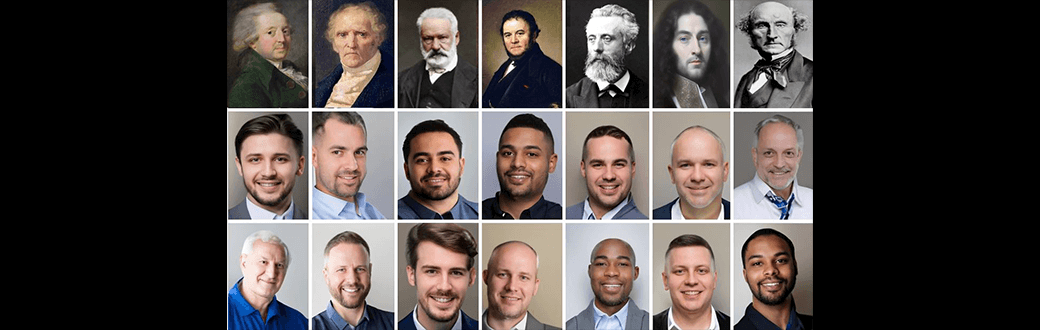
Here is a small gallery of these historic “allies.”
François Poullain de la Barre: Equality as a Logical Process
François Poullain de la Barre was a 17th-century theologian and philosopher. He adhered to a rigorous form of Cartesianism, and it was by applying the principles of the master of logic that he addressed gender inequalities. In his work published (anonymously) in 1673, *On the Equality of the Two Sexes: A Physical and Moral Discourse Showing the Importance of Overcoming Prejudices*, he first and foremost denounced the inconsistency of stereotypes. Inequalities are not natural, he asserts; they are the result of prejudices clouding one’s thinking. In another work, the highly ironic *On the Excellence of Men Versus the Equality of the Sexes*, Poullain de la Barre highlights the sheer irrationality of the arguments aimed at demonstrating the superiority of men.
Condorcet: In Favor of a Healthy Democracy
Condorcet, a philosopher of the Enlightenment, also appreciates the logic of things. Consequently, he takes issue when he observes that his humanist colleagues are considering achieving equality among all men… Except for women! For him, democracy cannot function if humanity is divided into political beings (men) and non-political beings (women and slaves). There is only one humanity, he said; it is a general principle that admits of no exceptions. But he also said that democracy cannot be government of the people by the people if it fails to take into account half of the people, to give them a voice, and to grant them equal rights. His words fell on deaf ears: the Estates-General agreed only to open the 1789 cahiers de doléances to a few female representatives of the “female sex.” But there was no question of them taking a seat in the Assembly! As everyone knows, it would not be until 1945 that this flaw in the republican project would be rectified.
John Stuart Mill: The Father of the “Diversity = Performance” Paradigm
John Stuart Mill was a 19th-century utilitarian economist. His philosophy is based on the interests of economic agents. In his work *On the Subjection of Women* (1869), he demonstrates that mistreating half of humanity is a misguided course of action. For example, he explains that it is in everyone’s best interest to provide women with a good education so that they can pass on knowledge and values to their children. But he goes even further by arguing that there are not enough talented men available to afford to do without intelligent women. For him, it’s clear: if we want more economic growth and better performance, we must involve talented women in decision-making… And do without men who are less capable than they are!
Stendhal: The Champion of Enhanced Civilization
The 19th-century writer Stendhal partly shares John Stuart Mill’s view when he states: “Granting women perfect equality would be the surest sign of civilization, and it would double the intellectual powers of humankind.” But he does not frame the debate in terms of economic performance. For him, the issue is one of civilization: it is about grasping the complexity of reality and nurturing lofty ambitions for humanity. As a man of his century who viewed past eras as barbaric (he was wrong, but that’s another story), he saw the subordination of women as an outdated notion, a prehistoric burden that prevents humanity from moving forward and envisioning a promising future.
Victor Hugo: Men’s happiness depends on the status of women
Another 19th-century writer took a stand on gender equality. Victor Hugo, in fact, argued in the intellectual and political circles of his time that women should cease to be “the slaves of our civilizations.” In his view, “even from the standpoint of our own self-interest, it is difficult to reconcile a man’s happiness with a woman’s suffering.” He believed, for example, that a man can never know if he is truly loved by his partner as long as she depends on him for her material survival and social standing. He tells us that women must have the choice to love men and build a life with them in order to be certain of the sincerity of their feelings. Consequently, Hugo became involved with the nascent feminist movement, notably by supporting the 1872 Banquet for Women’s Rights.
Charles Fourier: There Can Be No Social Progress Without Progress Toward Gender Equality
Among Victor Hugo’s political opponents was the philosopher Charles Fourier, who criticized Hugo for his views on the empire. But the two men agreed on the conviction that society cannot function properly unless women occupy their rightful place—that is, on an equal footing with men. Charles Fourier, who is said to have coined the word “feminism,” wrote as a sociologist with a capital “S.” Interested in the systemic conditions that produce poverty, violence, and a loss of meaning, he identifies gender inequality as an obstacle to social progress. He believes there can be no progress in the conditions of male workers without progress in the conditions of female workers. He adds that one cannot liberate men from the abusive power of the state or the employer while allowing them to exercise abusive power over women in private spheres.
Léon Richer: From Legal Equality to Actual Equality
Described as the “founder of feminism” by Simone de Beauvoir, the free-thinking journalist Léon Richer became aware of gender equality at a very early age: initially outraged by the sections of the Civil Code that treated women as “eternal minors,” he founded the weekly newspaper *Le droit des femmes* in 1869. But Richer quickly realized that changing the law alone was not enough to bring about true equality. As a result, he put forward a host of proposals aimed at ensuring that legal rights were effectively upheld: measures for equal pay, support groups for women who were victims of domestic violence, lobbying for women’s access to property and their own means of payment…
These historical figures offer only a glimpse of men’s commitment to equality over time. There are many others, not to mention the countless anonymous individuals. So today’s men can feel fully justified and perfectly consistent when they take action in support of gender parity: they are following the course of history.
Similar news stories
-

When Inspiration Comes from Elsewhere: Three International Initiatives We Can Learn From
-

3 Initiatives That Make a Difference in the Fight for Gender Equality
-

5 Cultural Recommendations for This Summer
-

The 5 Key Milestones in the Advancement of Women’s Rights That We Owe to Europe
-

The 5 European Leaders Driving Gender Equality
-

5 Resources to Help Ensure Women Are No Longer Invisible in History
-
Five Feminist Figures in Mentoring
-

Our Recommendations: Gender Equality in Music